Local sources from Greece: iEidiseis, Documento.
UK coverage: ITVX.
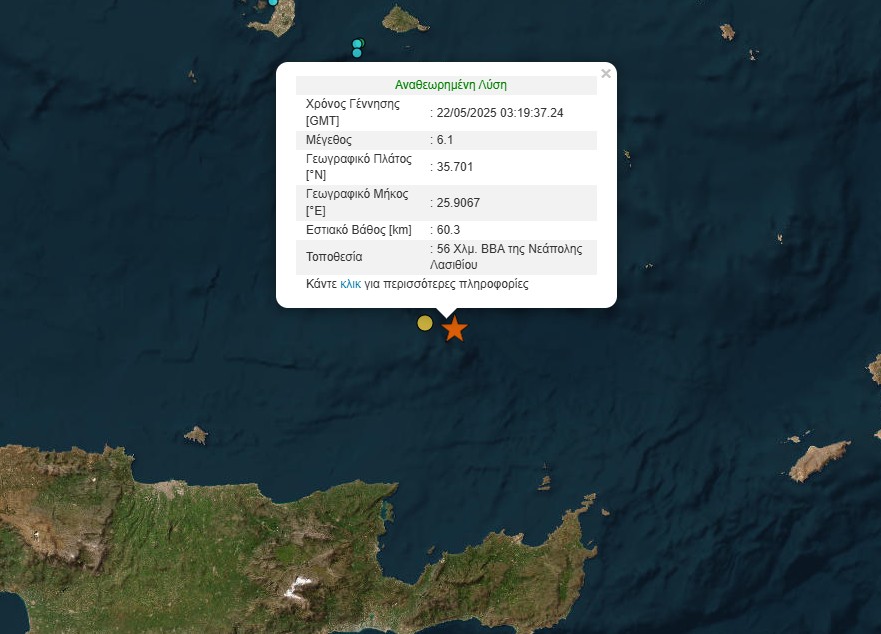
In the early hours of Thursday, a 6.1 magnitude earthquake struck 55km north of Crete, at a depth of 37km, stirring panic and leading to a tsunami warning across Greece. The tremor, felt across the southern Aegean, Attica, as well as distant countries including Israel, Egypt, and Turkey, prompted immediate advisories from Greek emergency services urging residents to evacuate coastal areas as a precautionary measure. Despite the initial alarm, the Greek Civil Protection Minister Ioannis Kefalogiannis later assured that the significant depth of the earthquake’s epicenter minimized the potential for major damage, alleviating fears of a tsunami or substantial infrastructural harm, particularly in Crete’s capital, Heraklion, where only minor damages were reported without any injuries. The Geodynamic Institute noted the quake’s long duration but confirmed no immediate damage on Crete or the surrounding islands. Efthymios Lekkas, president of the Earthquake Planning and Protection Organization (EPPO), emphasized the importance of the earthquake’s deep focal point, suggesting it significantly reduces the chance of a tsunami event. The earthquake’s occurrence in a trench rather than the Greek arc further supports assessments predicting minimal damage. Lekkas speculated that this could be the main quake, due to the difficulties for deep earthquakes to manifest more prominently, while also clarifying its distinction from previous seismic activities in regions like Santorini or Arkalochori, attributing it to the tectonic interactions between the African and European plates. The event has prompted the UK Foreign Office to update travel advisories due to increased seismic activities in Greece, a country known for its seismic vulnerability. The swift response and ongoing assessments by Greek authorities highlight the region’s preparedness for such natural phenomena, aiming to mitigate any potential risks to residents and visitors alike.
 TheLittleTwentieth - Renowned Papers Edition, AI Infused