Local sources from France: Le Monde, 20 Minutes.
UK coverage: European Space Agency.
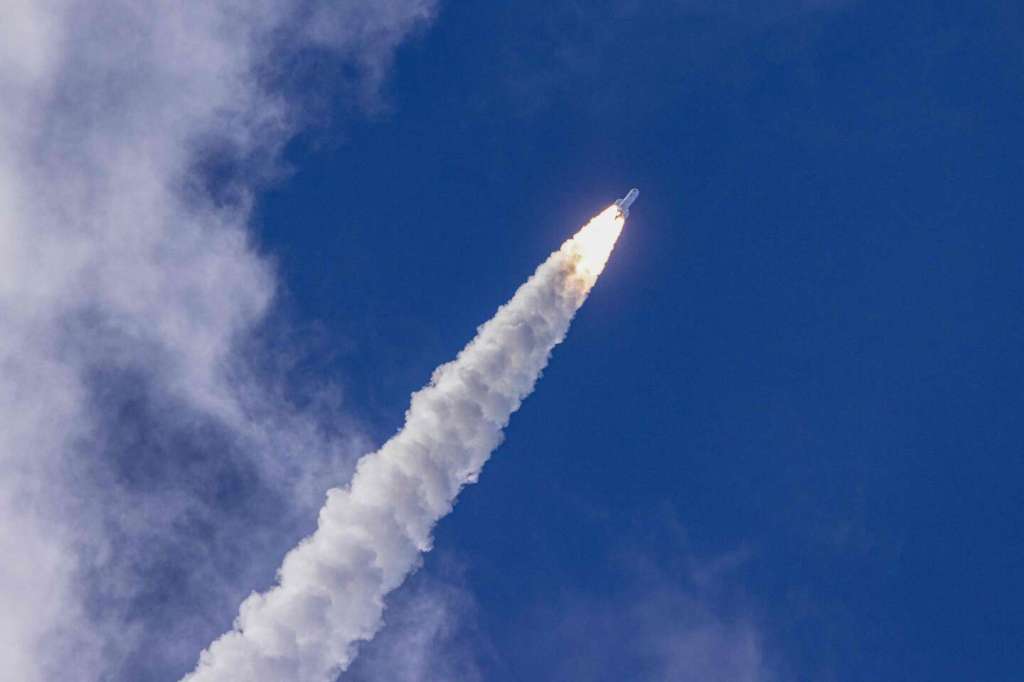
Europe’s new heavy-lift rocket, Ariane 6, successfully made its inaugural flight from Europe’s Spaceport in French Guiana. The rocket, which replaces the Ariane 5, has a modular design that allows it to launch missions from low-Earth orbit and deep space. The demonstration flight, designated VA262, showcased the capabilities of Ariane 6 in escaping Earth’s gravity and operating in space. It also carried several satellites and experiments from various space agencies, companies, research institutes, universities, and young professionals. The success of this first flight marks the beginning of Ariane 6’s operational career, providing Europe with autonomous access to space.
The launch of Ariane 6 was a historic moment for Europe, as it restored the continent’s sovereignty in the space domain. The four-year delay of the program was forgotten as applause filled the control room at the Guiana Space Centre (CSG) in Kourou. The successful launch was a response to the challenge posed by Elon Musk’s Falcon-9, which had revolutionized the market with its lower prices. The teams had eagerly awaited this moment, and now they are ready to launch Ariane 6 as quickly as possible.
The Ariane 6 rocket, measuring 62 meters in length with a diameter of 5.40 meters, is larger than its predecessor, Ariane 5. It is a modular launcher that can be configured with two or four boosters, depending on the mission requirements. The rocket also offers two different fairings, allowing for the adaptation to various customer needs. Its upper stage is equipped with the restartable Vinci engine, enabling maneuvers in space to place payloads on different orbits during a single flight.
One of the main advantages of Ariane 6 is its reduced launch costs. The production costs are 40 to 50% lower than those of Ariane 5, achieved through increased efficiency in the production chain and the digitization of production. The launch rate of Ariane 6 will be doubled compared to its predecessor, further reducing the launch cost. The rocket construction factories use the principles of the aerospace industry, which has lower costs compared to space-specific approaches.
Ariane 6 is part of a family of European launchers, incorporating elements from its predecessor and the Vega light launcher. The boosters of Ariane 6 are an evolved version of the first stage of Vega, contributing to the idea of a family of European launchers. The successful launch of Ariane 6 marks a significant milestone for Europe, providing the continent with independent access to space and ensuring its competitiveness in the global space market.
 TheLittleTwentieth - Renowned Papers Edition, AI Infused