Local sources from India: Aaj Tak, News18 हिंदी.
UK coverage: The Guardian.
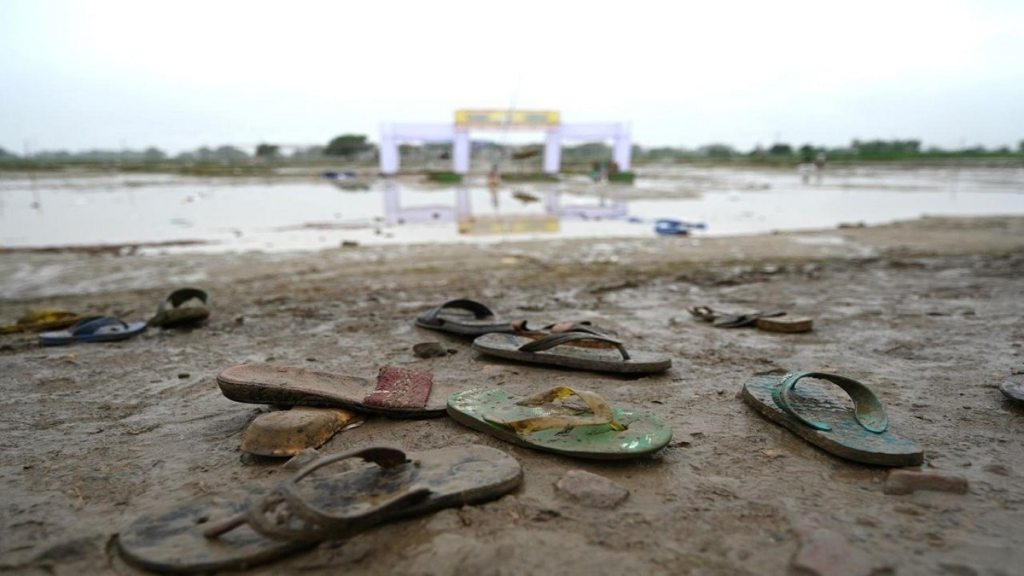
Relatives of the victims of a deadly crowd crush during a Hindu religious gathering in northern India have accused authorities of negligence. Over 120 people died and many were injured when panic broke out at the event attended by 250,000 people. Witnesses and victims’ families claim that there was a lack of medical staff, ambulances, and police on site, leaving them to dig through the mud to find the dead and injured. The hospital also faced a shortage of beds and doctors, resulting in delayed treatment and deaths. Six people, including aides to the spiritual guru who organized the event, have been arrested.
Before the tragic incident in Hathras, there have been stampedes resulting in deaths in Prayagraj, Varanasi, and Pratapgarh as well. Let’s find out if any action was taken to investigate these incidents.
In Hathras, Uttar Pradesh, 121 people lost their lives in a stampede during a religious gathering, most of whom were women and children. This is one of the most horrific incidents in recent years. The religious gathering was organized by Narayan Sakar Hari, also known as Sakar Vishwa Hari or Bhole Baba. Following this tragic incident, the Governor of Uttar Pradesh, Anandiben Patel, formed a three-member commission to investigate the incident. An FIR has also been registered, but it does not include the name of Narayan Sakar.
Hathras is not an isolated incident, and India has a long history of deadly stampedes during religious gatherings. Here, we will discuss three major incidents of stampedes in Uttar Pradesh. We will also explain what happens after a stampede and how investigations are conducted.
2013 Kumbh Stampede:
Incident: On February 10, 2013, a stampede occurred at the railway station in Prayagraj, resulting in the death of more than 40 people. According to eyewitnesses, when railway officials announced a last-minute platform change, a crowd of people surged.
Government’s Indifference: Two days after the stampede, on February 12, 2013, Chief Minister Akhilesh Yadav visited Allahabad. The then Urban Development Minister Azam Khan, who was in charge of the Mahakumbh festival in Allahabad, resigned taking moral responsibility, but the CM rejected his resignation, praising Khan’s work in organizing the grand event. Within 24 hours of the stampede at Allahabad railway station, a blame game between the state government and the railways began.
Order for Investigation: On February 17, 2013, the Uttar Pradesh government ordered a judicial inquiry into the stampede by retired High Court Judge Omkareshwar Bhatt. Prior to this, the then Chief Minister of Uttar Pradesh, Akhilesh Yadav, had ordered an investigation by the Uttar Pradesh Revenue Board Chairman Jagan Mathews.
Investigation Findings: On August 14, 2014, the report of the judicial commission was submitted to the then Governor of Uttar Pradesh, Ram Naik. The report held the railways, Uttar Pradesh State Road Transport Corporation, Allahabad administration, and police responsible for the stampede. In July 2014, the Comptroller and Auditor General (CAG) presented a report in the Uttar Pradesh Legislative Assembly, which mentioned several irregularities related to the stampede. The report stated that even after the start of the fair, 59% of the construction work and 19% of the supply were not completed. In addition, out of the approved 111 construction works, 81 were done without technical inspection. The CAG report also found that no scientific criteria were adopted in planning or coordination between various departments and institutions working for the Kumbh Mela, and no detailed project report was prepared.
Status Report: In January 2019, it was reported that the Yogi government had given permission to present the report of the judicial inquiry into the stampede in the state assembly. However, there is no fresh information available in the public domain regarding the post-2019 report.
2016 Varanasi Stampede:
Incident: On October 15, 2016, a stampede occurred on the crowded Rajghat Ganga Bridge in Varanasi, resulting in the death of 25 people. A large number of followers of the Jay Gurudev sect were heading to a two-day religious gathering in Domri village on the banks of the Ganges.
Government’s Indifference: The deceased leader of the Jay Gurudev sect, Pankaj Maharaj, expressed grief over the incident, but the organization distanced itself from any responsibility. He had stated that in the future, they would organize even larger spiritual programs.
Order for Investigation: On October 18, 2016, Chief Minister Akhilesh Yadav ordered a judicial inquiry into the incident under the chairmanship of retired High Court Justice Rajmani Chauhan, who was given two months to submit an initial report. An FIR was registered against Pankaj Maharaj, the main accused, in connection with the Varanasi stampede. He was also charged with providing false information to district officials about the size of the crowd attending the religious congregation.
Investigation Findings: On July 23, 2019, the state government presented the Action Taken Report (ATR) on the Varanasi stampede in the state assembly. The report stated that the police did not take action against Pankaj Maharaj. The commission found that Pankaj Maharaj had misled the police and district administration about the size of the crowd when requesting permission for the grand procession.
Action Taken: Chief Minister Yogi Adityanath signed the ATR in 2019 and informed the assembly that the recommendations of the commission had been implemented.
2010 Pratapgarh Stampede:
Incident: On March 4, 2010, a stampede occurred at the Ram Janaki Temple in Pratapgarh, resulting in the death of 63 people and more than 100 injuries. It is believed that the incident happened due to the collapse of the unfinished gate of the temple, causing chaos among the devotees who had gathered for free meals and clothes on the anniversary of Kripalu Maharaj’s wife. On March 5, a case of negligence against the management was registered due to the lack of arrangements for the cremation of the deceased.
Government’s Indifference: There was no arrangement made for the cremation of the deceased after the incident. Local people claim that the district administration failed to provide enough firewood for the cremation. In a Zee News report, it was alleged that Kripaluji Maharaj was held responsible for this tragedy. According to the report, Kripaluji Maharaj said, “We did not invite anyone for free meals. A large number of devotees came to my ashram on their own, so they are responsible for what happened.”
Order for Investigation: The then Chief Minister Mayawati ordered a high-level inquiry into the stampede. Cabinet Secretary Shashank Shekhar Singh announced in a press conference that the investigation would be conducted by the Allahabad divisional commissioner, who was given 24 hours to submit an initial report.
Investigation Findings: The preliminary investigation found the management and organizers of the anniversary celebration and the trustees of Jagadguru Kripalu Bhakti Dham Trust responsible for poor arrangements and crowd control measures. The investigation found that the entrance gate of the ashram was also incomplete, which led to the tragedy.
Action Taken: On March 5, 2010, an FIR was registered against the organizers and managers of the ashram at the Kundapulice station, but no names were mentioned in the case.
According to a study published in the International Journal of Disaster Risk Reduction in 2013, 79% of stampedes in India occur during religious gatherings and pilgrimages. The study highlights that religious mass gatherings often take place in rural areas of India, where there is limited space and inadequate infrastructure, increasing the risk of such accidents.
A study titled “Trends in Crowd-Generated Accidents Based on Analysis of Press Reports” published in Safety Science in 2023 reveals that India is increasingly becoming a hotspot for crowd-related accidents, with religious festivals being the most responsible for this dangerous trend. The study indicates that India and to some extent, Western Africa, appear to be hotspots for crowd-related accidents. According to the study, approximately 70% of the accidents (33 out of 48) that occurred in India between 2000 and 2019 were related to religious gatherings.
 TheLittleTwentieth - Renowned Papers Edition, AI Infused