Local sources from Kenya: The Guardian, The Guardian.
UK coverage: Sky News.
The funeral of 19-year-old Ibrahim Wanjiku, who was shot while protesting in Nairobi, highlights the impact of recent deadly protests in Kenya. Wanjiku’s best friend and neighbor, Eugene, mourns his loss and expresses his reluctance to continue protesting after witnessing his friend’s death. However, other young men in Kenya are determined to continue the fight for justice, scheduling more civil disobedience in the coming days. Veteran activist Boniface Mwangi believes that the younger generation, who have grown up in a unified and non-tribalist country, have lost their innocence and that Kenya will never be the same again.
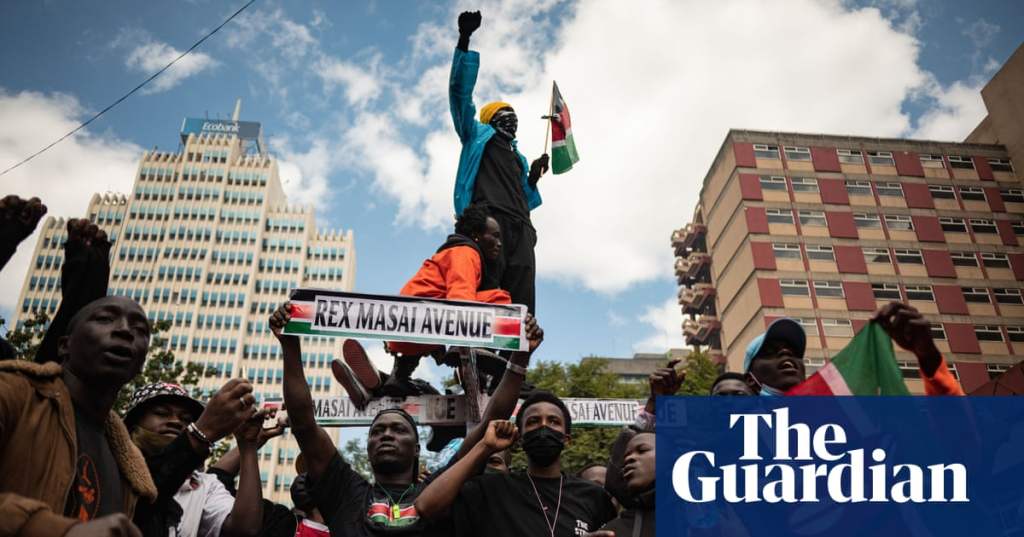
Kenya’s youth-driven, leaderless protest movement finds itself at a crossroads this weekend, buoyed up by President William Ruto’s surprise decision on Wednesday to abandon a finance bill containing planned tax rises even as it mourns those killed in deadly violence the day before. The movement that brought thousands of people out on to the streets in recent weeks, against the backdrop of a cost of a living crisis that has left many young people feeling hopeless, has little precedence in Kenya where protests are traditionally elite-led. Frustrations that led to the unrest has been simmering for years as economic growth has failed to keep pace with population growth. “Any government must be seen to be in charge and firm but flexible enough to accommodate the views of its citizens,” Manyora said. “Ruto’s government seems to be learning this the hard way, and that’s why they are conceding and making changes almost at the gen Z gunpoint.” The unrest may have been sparked by the finance bill, but frustrations have been simmering for years in a country where economic growth has failed to keep up with population growth and generation Z – people born between 1997 and 2012 – has struggled to find employment. Elected in 2022 on promises to lift up people with low incomes and reduce the cost of living, Ruto has made a series of unpopular financial policy moves, including removing fuel and maize flour subsidies, introducing a housing levy and proposing a health insurance programme with higher costs for contributors. Opposition to the tax bill started online. Young Kenyans used X, TikTok, Instagram and other platforms to vent their frustrations, crowdfund and mobilise street protests. Videos were published in different languages explaining the bill, which helped the movement transcend ethnic groups. The first major street protests took place on 18 June, organised under the social media hashtag #RejectFinanceBill2024. In response, legislators amended the bill to remove some of the planned tax rises, but the compromise did not go far enough. On 20 June, more people came out to demonstrate across the country. One person was killed and more than 200 were injured, and lawyers and rights groups said people suspected of involvement were abducted by security forces. The violent response and disappearances galvanised protesters, culminating in the scenes on Tuesday when some people stormed into parliament and government offices, setting parts of them on fire. At least 23 people were killed as the police responded with live fire and teargas, according to the Kenya Medical Association. A day later, Ruto pulled the bill and made an unspecific offer of dialogue. The U-turn split demonstrators: in an X Spaces discussion on Wednesday night attended by more than 80,000 people, there was fierce division over whether to press ahead with a planned march on Ruto’s residence on Thursday. In the end the march didn’t happen. Some protests took place in several cities, but on a smaller scale to Tuesday’s. Anna Otieno, 21, who participated in a protest in Nairobi on Thursday, said she had been motivated by her anger at the violent response earlier in the week. “We’re almost going down the route of a dictatorship country,” she said. “We can’t even voice our rights as we come for peaceful demonstrations.” Online and in the streets, many of the protesters’ demands have shifted to justice for those killed, the release of those arrested, and Ruto’s resignation. “They have killed us. They can’t lead us. That’s what we are saying,” said Albert Otieno, a lawyer, said during a protest in Nairobi on Thursday. How the movement maintains unity and momentum while pursuing broader goals is a pressing question. Christine Odera, a co-chair of the Kenya Coalition on Youth, Peace and Security, a civil society organisation, said it needed to formalise its structures to advance young people’s interests and speak to the government. “If we go organically then we might lose the whole conversation,” she said. “The president has said we need to have conversations. All of us cannot sit in a stadium and have a conversation.” Others disagree. Ojango Omondi, of the Social Justice Centres Working Group, a community activist group in a poor district of Nairobi, said establishing structures and national representatives could allow the movement to be corrupted by politicians. “We don’t need to negotiate anything,” he said. “All we want is better living conditions. All we want is the leaders to stop using our resources … to sponsor their lavish lifestyle.”
 TheLittleTwentieth - Renowned Papers Edition, AI Infused