Local sources from United States: Dezeen, California State Parks.
UK coverage: Dezeen.
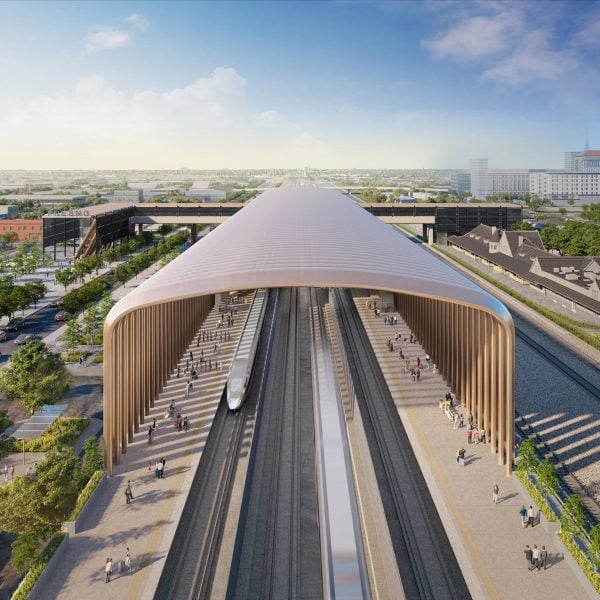
Designs for the first four train stations of the California High-Speed Rail line have been unveiled by Foster + Partners, Arup, and Page & Turnbull. The stations will be located in Merced, Fresno, Kings Tulare, and Bakersfield as part of Phase 1 of the project. The designs feature architectural elements that reflect the sustainable ethos of the wider project, including soaring canopies and integrated louvred wood and stone walls. The historic depot in Fresno will also be restored and serve as an ‘ultramodern transportation center’. The Central Valley line is expected to start service in 2030.
Renovation of historic station among designs unveiled for California’s high-speed rail
Designs by studios Foster + Partners, Arup and Page & Turnbull have been unveiled for the first four train stations of the California High-Speed Rail line, slated to be the first high-speed rail system in the US. Foster + Partners and Arup contributed to the design of four stations for the California High-Speed Rail, which will connect San Diego in the south of the state with Sacramento in the north, as well as a number of cities in between. As part of Phase 1 of the project, which will run from San Francisco to Los Angeles, the stations will be located in Merced, Fresno, Kings Tulare and Bakersfield, with initial designs announced last year. According to Foster + Partners, the four Central Valley stations will be linked by an architectural language ‘that reflects the sustainable ethos of the wider project’ and will feature ‘soaring’ canopies. ‘We are developing an architectural language for the four Central Valley stations, including soaring canopies that draw in fresh air and shield waiting passengers from harsh sunlight,’ said Foster + Partners head of studio Stefan Behling. ‘The station design reflects the sustainable ethos of the wider project.’ Renderings show each station’s exteriors and interiors capped by ripped volumes of metallic bronze or matte white, integrated with louvred wood and stone walls, heavy columns, and pergola-style roofs hanging over large entrances. The project’s Fresno station will include an elevated pedestrian crossing connecting Chinatown and Downtown Fresno Station near Mariposa Street, as well the restoration of the historic depot on site conducted by US architecture studio Page & Turnbull. Built in 1872 and listed in the National Register of Historic Places, the depot is a Queen Anne-style building with slate bellcast hip-roof and cupolas and a structure of red brick. Updates to the station will include bringing the building up to fire, life-safety, structural, seismic and accessibility codes, as well as the restoration of architectural features so that it can serve as an ‘ultramodern transportation center’. ‘The historic depot will be an iconic and economically vital part of Downtown Fresno and of the high-speed rail system,’ said Page & Turnbull president Peter Birkholz. Located north of Fresno, the Merced station will also include a pedestrian bridge linking the city’s downtown, and serve as the main connection to the greater San Francisco Bay Area. A ‘flexible outdoor plaza’ on 16th Street is also included in the plans. ‘Building on the historical link between Merced and Yosemite Valley, this city with a rapidly growing university and college will benefit from high-speed rail connections to the Central Valley and the future connection to the San Francisco Bay Area,’ said the team. The Kings Tulare station is pictured with an expansive outdoor plaza and is designed to create ‘a streamlined experience’ for bus, car and bicycle traffic, with its services located in a rectangular volume directly beneath its tracks. As the southern terminus of the line and the connection to Los Angeles and Anaheim, the Bakersfield station will feature a variety of shaded outdoor plazas, with renderings picturing outdoor amenities beneath elevated tracks. ‘The design creates a linear park that runs underneath a new viaduct, directly connecting downtown Bakersfield and the Kern River Corridor with a variety of shaded outdoor public spaces and recreation facilities,’ said the team. Once completed the 119-mile Central Valley line will connect San Francisco to Los Angeles in less than three hours, according to the team. Up to 24 stations are planned for the greater California High-Speed Rail, linking more than 800 miles of track. Funding was granted to the project in 2008 after decades of advocacy. First proposed in 1979 under Governor Jerry Brown, California’s high-speed rail has since suffered a number of funding setbacks and controversies, resulting in the current two-phase construction plan for the rail. Phase 1 of the project refers to the completion of the 520-mile San Francisco to Anaheim route, while Phase 2 refers to extensions that will connect Sacramento and San Diego. According to the New York Times, due to ‘political compromises’, the project’s budget has bloated to an estimated $100 billion with ‘little chance’ of completion – although construction on viaduct structures and overcrossing is underway according to updates from the California High-Speed Rail Authority, a body tasked with facilitating the project. As of now, service of the Central Valley line is expected to start in 2030. The opportunity to learn more about the rail stations, see 3D renderings and speak with rail authorities will be available to the public during the California State Fair in Sacramento running from 12 to 28 July, according to Foster + Partners. Elsewhere in the US, a historic train station in Detroit recently received a renovation, while New York’s subway station risks ‘falling behind’ after budget cuts.
Pigeon Point Lighthouse Rehabilitation Project to Begin in Early 2024
California State Parks today announced the selection of a contractor to rehabilitate the Pigeon Point Lighthouse, located within Pigeon Point Light Station State Historic Park. The $16 million rehabilitation project will start construction in early 2024 and is expected to be completed within two years. Named for the 1853 wreck of the clipper ship Carrier Pigeon, Pigeon Point Lighthouse was first lit on Nov. 15, 1872. The 115-foot structure is the tallest operating lighthouse on the West Coast. Pigeon Point Light Station is listed on the National Register of Historic Places—a reminder of the days when whalers and Gold Rush-era clipper ships fought gales, stiff seas, jagged coastal rocks, and unforgiving fog. The lighthouse has been closed to the public since late 2001, when it was deemed unsafe after two large pieces of brick and iron fell from the top of the building. Funding issues, COVID-19, and a thoughtful process to ensure a contractor with the special skills to work on a lighthouse was selected have been the reasons for the continued closure of this historic building. ‘California State Parks looks forward to once again providing public access to this historic landmark that continues to guide mariners along the rocky San Mateo County coast,’ stated Santa Cruz District Superintendent Chris Spohrer. ‘Thank you to our partners for their support over the years and the public for their patience.’ Sustainable Group, Inc. of Moraga, California, and subcontractor ICC Commonwealth of North Tonawanda, New York, have extensive experience in lighthouse rehabilitation and restoration in the United States. Jointly, they have worked on nearly 100 lighthouses, including several built to the same blueprints as Pigeon Point, including Bodie Island, North Carolina; Currituck Beach, North Carolina; and Yaquina Head, Oregon, as well as numerous other tall lighthouses. For the Pigeon Point Lighthouse, the contractors will refurbish or replace all the ironwork throughout the building. Masonry elements will also be repaired or replaced as needed. A major focus of the project will be the upper belt course or cast-iron ring where two large pieces broke away in late 2001, compromising the building’s structural integrity. Pigeon Point Light Station State Historic Park relies upon its collaborative relationships with its nonprofit partners, including Coastside State Parks Association, California State Parks Foundation, and Friends of Santa Cruz State Parks. These organizations provide support for the tower restoration, the operation of the park, and the development of visitor-serving programs and amenities.
 TheLittleTwentieth - Renowned Papers Edition, AI Infused