Local sources from Philippines: The Guardian, FRANCE 24 English.
UK coverage: BBC.
In a recent incident in the disputed South China Sea, Filipino soldiers engaged in a physical confrontation with Chinese coast guard personnel. The clash occurred as the Philippine navy and coast guard were delivering supplies to Filipino troops stationed in the area. The Chinese coast guard, armed with swords, spears, and knives, attempted to block what they claimed was an ‘illegal transportation’ of supplies. However, the Philippines has accused the Chinese of piracy, stating that their boats were rammed, punctured with knives, and boarded by Chinese personnel. The confrontation escalated as Filipino soldiers fought off the Chinese using only their bare hands. The incident marks a significant escalation in the ongoing tensions between the two sides.
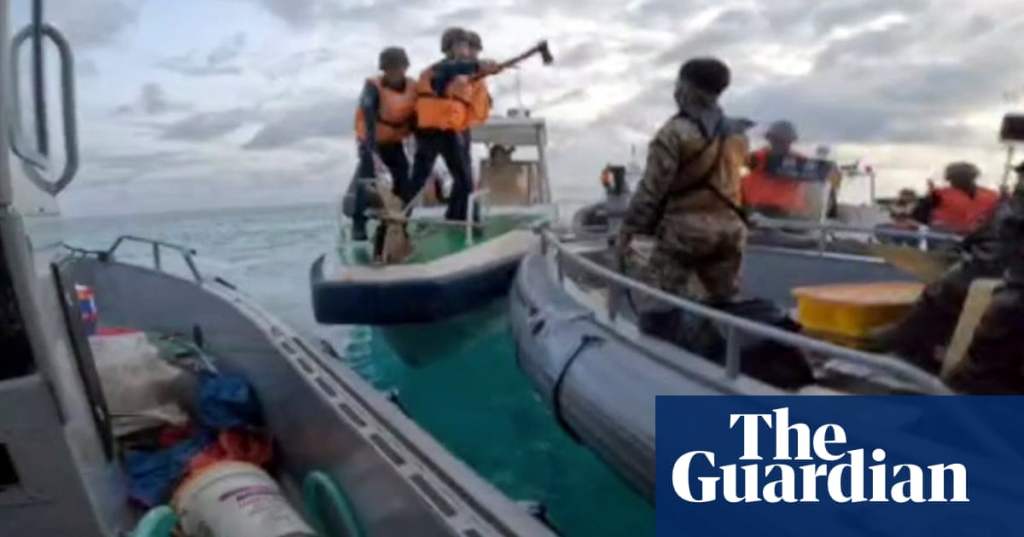
The Philippines military has released photos showing the extent of the damage caused by the Chinese coast guard. The photos depict a Chinese coastguard brandishing an axe at Filipino forces and smashed windshields and communication equipment on a Philippine navy boat. The military also reported that one Filipino sailor lost a thumb in the confrontation, and personal mobile phones were seized, along with unopened cases containing guns. The Philippines has demanded that China return their rifles and equipment and pay for damages caused.
China, on the other hand, has blamed the Philippines for the collision and denied responsibility for the violent confrontation. They claim that their coastguards acted professionally and restrained. However, the US State Department has condemned China’s actions, stating that it threatens regional peace and stability. The US-Philippines mutual defense treaty extends to armed attacks on Philippine armed forces, public vessels, or aircraft in the South China Sea, reaffirming their support for the Philippines.
The incident took place near Second Thomas Shoal, a submerged reef in the Spratly Islands, within the Philippines’ exclusive economic zone. The Philippines had been attempting a resupply mission to the BRP Sierra Madre, a second world war-era ship serving as a military outpost in the shoal’s shallow waters. This area has been a major flashpoint in the region.
The chief of staff of the Philippines armed forces, Gen Romeo Brawner Jr, described the Chinese behavior as ‘piracy’ and revealed that the Chinese coastguard brought bolo knives, spears, and knives. Filipino personnel fought back with their bare hands, although they were outnumbered. Guns carried on the Filipino boats were disassembled and in gun cases as a precautionary measure. The incident has raised concerns about the growing risk of miscalculation that could inadvertently provoke conflict and draw in the US, an ally of the Philippines.
The South China Sea is a fiercely contested area, with China claiming almost 90% of its territory. However, an international tribunal in The Hague has rejected China’s claims. The Philippines, Vietnam, Malaysia, Brunei, and Taiwan also have overlapping claims in the region. As maritime confrontations continue to escalate, there is a growing fear of a wider conflict that could involve the US and other allies. The South China Sea is a vital waterway for trade, with trillions of dollars in ship-borne trade passing through annually. Additionally, the area is believed to hold significant untapped oil and gas deposits.
This recent clash between the Philippines and China highlights the ongoing tensions and territorial disputes in the South China Sea. The international community, including the US, has condemned China’s actions and expressed concerns about the potential for further escalation. As the situation unfolds, it remains to be seen how the involved parties will navigate these complex and contentious waters.
 TheLittleTwentieth - Renowned Papers Edition, AI Infused