Local sources from Belgium: EURACTIV France, Le Soir.
UK coverage: The Guardian.
EU leaders are currently deliberating over the possibility of granting Ursula von der Leyen a second term as head of the European Commission. While her European People’s Party emerged victorious in the European Parliament elections, several hurdles lie ahead. Concerns have been raised regarding corruption allegations against António Costa, the favored candidate for the presidency of the European Council, as well as the lack of support from Hungary’s Prime Minister, Viktor Orbán. Von der Leyen’s ultimate success will also depend on securing the support of the European Parliament in a vote scheduled for July.
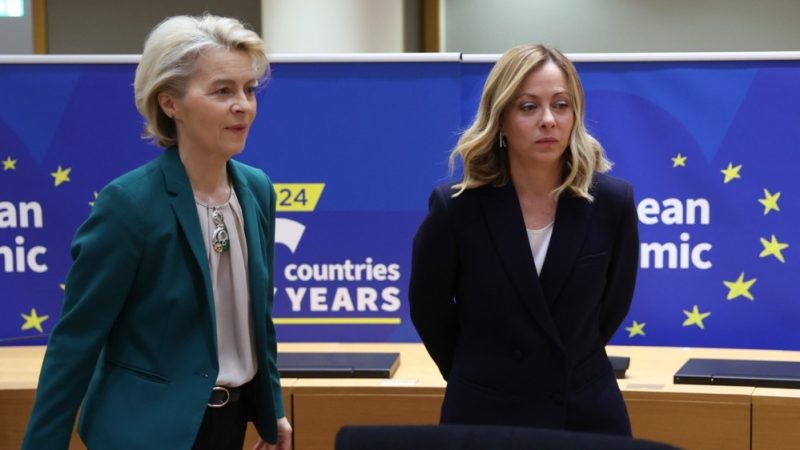
Speculations surrounding Ursula von der Leyen’s second term have been circulating since the European elections. Italian Prime Minister Giorgia Meloni commented on the matter, stating that it is too early to determine whether von der Leyen will secure another term. Meloni emphasized the need to gather data and evaluate potential majorities within the European Parliament. Prior to the elections, Meloni had been approached by both von der Leyen and Marine Le Pen, leader of the National Rally party. Meloni aims to unite right-wing parties in Europe, and her party, Brothers of Italy, has performed well in the elections, consolidating its power in the country.
Ursula von der Leyen, known for her impressive political career, is now a candidate for a second term as President of the European Commission. She has a diverse background, having been a fan of punk music and an avid follower of seventies culture during her time at the London School of Economics and Political Science. Von der Leyen’s leadership has faced criticism, particularly regarding the geopolitical consequences of recent events in the Middle East. Josep Borrell, the High Representative, acknowledges the global discontent with what is perceived as a double standard in international affairs. The reluctance of the global South to align with European sanctions against Russia further complicates the situation.
As EU leaders continue their discussions and negotiations, the fate of Ursula von der Leyen’s second term hangs in the balance. The obstacles posed by corruption allegations and lack of support from key figures within the EU must be overcome. The European Parliament’s vote in July will ultimately determine whether von der Leyen will continue to lead the European Commission. The outcome of this decision will have significant implications for the future of the EU and its ability to address global challenges effectively.
 TheLittleTwentieth - Renowned Papers Edition, AI Infused