Local sources from Brazil: Agência Brasil, Terra.
UK coverage: The Guardian.
Brazil’s state of Rio Grande do Sul is currently facing the most extensive climate catastrophe in its history, as catastrophic floods have caused widespread devastation. Over 100 people have lost their lives, more than 130 are missing, and nearly 400 are injured in the affected municipalities. The extreme floods have been attributed to various climate factors, including intense wind currents, an atmospheric block, and a moisture corridor from the Amazon. The lack of maintenance of the flood protection system over the years is also seen as a contributing factor. The government estimates the damage to be around £2.9bn and has pledged to assist in the reconstruction and resettlement of affected individuals.
The government of Uruguay has stepped in to provide assistance in the rescue efforts. They have sent a helicopter and a team of eight people, including pilots, co-pilots, technicians, and rescuers, to aid in the rescue of people stranded by the rains in Rio Grande do Sul. Brazil expressed gratitude to Uruguay for their quick and efficient response in providing humanitarian assistance. The Uruguayan team is currently in Bagé, waiting for better weather conditions to proceed to Santa Maria, where they will begin their operations.
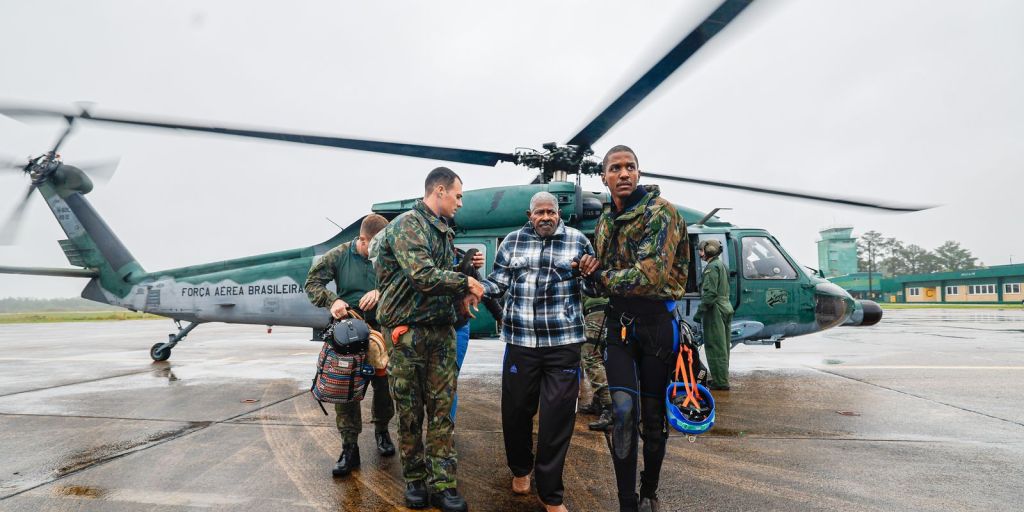
The rescue efforts have been extensive, with a task force consisting of 3,300 civil and military firefighters, police officers, and members of the Armed Forces working tirelessly to save lives. Teams from the federal government and nine other states, including Minas Gerais, Bahia, and Rio de Janeiro, have joined forces to assist in the rescues. The rescue fleet includes 1,400 vehicles, including aircraft, vehicles, and boats. The Armed Forces have mobilized 29 helicopters and four aircraft for the operations.
The number of people affected by the heavy rains and floods is staggering. So far, 17,900 people have been rescued, with 431 rescues in the Serra Gaucha region alone. However, the death toll continues to rise, with 66 confirmed deaths and another six under investigation. Additionally, 155 people have been injured, and 101 individuals are still missing. The scale of this disaster has surpassed the previous environmental catastrophe in 2023, where 54 lives were lost. Authorities are calling this the worst climatic disaster in the history of Rio Grande do Sul.
Rio Grande do Sul has been experiencing a series of extreme weather events, including both droughts and floods. The state endured nearly three years of relentless drought, resulting in agricultural crop failures and a decrease in its contribution to the country’s GDP. However, in the past six months, the state has been struck by two catastrophic floods, further exacerbating the situation. Experts attribute these extreme events to climate change, which intensifies the clash between tropical and polar systems in the region, making the climate more unpredictable.
While the attribution studies to determine the influence of climate change on these events have not yet been conducted, researchers assert that it is highly likely that climate change has played a significant role. The warming atmosphere and oceans generate more moisture and energy, leading to more potent storms and extreme weather events. Brazil, being highly vulnerable to climate change, needs to focus on both mitigation and adaptation. The government is already working on adaptation plans in various sectors, including agriculture, infrastructure, and cities, to address the challenges posed by climate change.
As Rio Grande do Sul grapples with the aftermath of these devastating floods, the international community must come together to support the affected communities and assist in the reconstruction and resettlement efforts. The resilience and strength of the people of Rio Grande do Sul will be tested, but with assistance and collective action, they will be able to rebuild and recover from this climate catastrophe.
 TheLittleTwentieth - Renowned Papers Edition, AI Infused