Local sources from Hungary: Index.hu, Magyar Nemzet.
UK coverage: Financial Times.
China is leveraging its diplomatic relationship with Hungary as a blueprint for engaging with other European countries. Hungary has emerged as a crucial partner for China in the region, with Chinese investments and trade playing a significant role in the Hungarian economy. Prime Minister Viktor Orban’s support for China’s Belt and Road Initiative has further strengthened the cooperation between the two nations in areas such as technology and infrastructure. This approach by China towards Hungary is seen as a strategic move to gain influence and expand its presence in Europe.
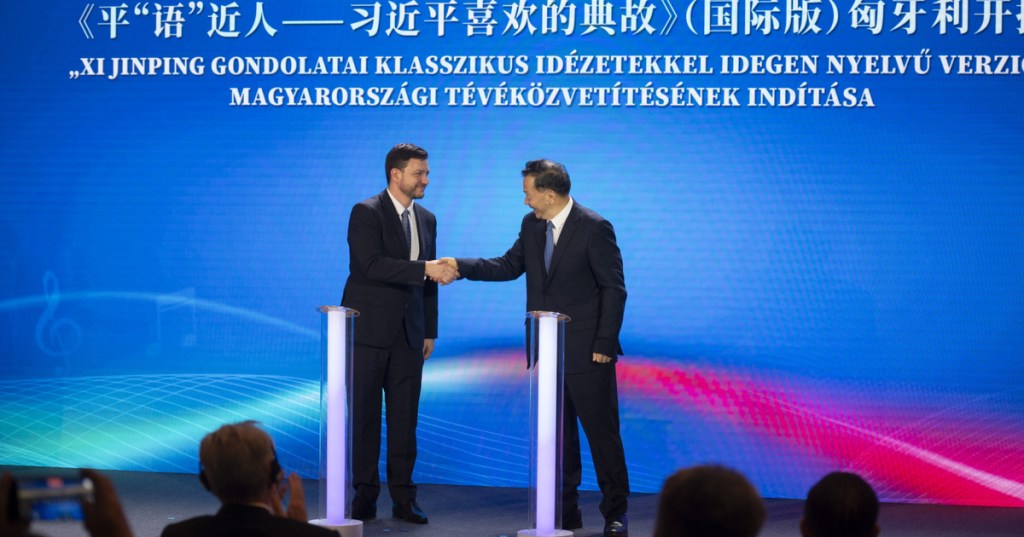
In celebration of the 75th anniversary of diplomatic relations between Hungary and China, public media in Hungary will broadcast documentary films showcasing Chinese culture. The Hungarian Public Service Media (MTVA) and China Media Group have signed a cooperation agreement for the presentation of these films. The collaboration between the two media companies is expected to benefit viewers the most, according to Dániel Papp, CEO of MTVA.
The China Media Group’s President, Sen Haj-Hsziung, visited Hungary to sign a partnership agreement with the China Media Group and the Media Support and Asset Management Fund. During the Hungarian premiere of a program curated by Chinese President Xi Jinping, which highlights Chinese culture, Sen Haj-Hsziung emphasized the importance of celebrating the Chinese-Hungarian friendship and discussing their shared future.
Hungary has been a long-standing partner and good friend of China in Europe. It was one of the first countries to establish diplomatic relations with China and the first European country to sign a cooperation document related to the Belt and Road Initiative. Dániel Papp, CEO of MTVA, highlighted the collaborative opportunities that the partnership between the China Media Group and MTVA brings, promoting dialogue between the two nations.
Chinese President Xi Jinping recently visited Hungary, starting his official program at the Buda Castle, where he was welcomed by the Hungarian delegation with military honors. During a joint press conference with Prime Minister Viktor Orbán, Minister of Foreign Affairs and Trade Péter Szijjártó announced the details of the agreements reached between the two countries.
China and Hungary have established a high level of mutual political trust, leading to the best period in the history of their bilateral relations. The two countries are now stepping together on the ‘golden waterway,’ focusing on the high-level construction of the Belt and Road Initiative and deepening cooperation in investment, infrastructure construction, finance, alternative energy, and communication technology. Hungary has become an important trading partner for China and a prime destination for Chinese investments in the Central and Eastern European region.
The cultural exchange between China and Hungary has also flourished. Documentary films produced in China will be showcased on Hungarian public media for the first time, while the Beijing Hungarian Cultural Center has been operating successfully for several years, and the Budapest Chinese Cultural Center is set to begin its activities soon. The two countries have also fostered people-to-people exchanges through educational programs, Confucius Institutes, and municipal relationships.
Chinese President Xi Jinping’s visit to Hungary aims to deepen the traditional friendship between the two nations and elevate their comprehensive strategic partnership to new heights. The visit focuses on strengthening the political foundation of bilateral relations, coordinating development strategies, expanding people-to-people exchanges, leading regional cooperation, and addressing global challenges together. China and Hungary share similar views on international and regional issues, upholding unity, cooperation, and the common values of humanity.
China’s diplomatic ties with Hungary serve as a model for its relations with other European countries, as it seeks to expand its influence and presence in Europe. With Hungary’s support for China’s initiatives and their deepening cooperation in various sectors, the partnership between the two nations is poised to shape the future of their bilateral relations and have broader implications for China’s engagement in Europe.
 TheLittleTwentieth - Renowned Papers Edition, AI Infused