Local sources from United States: Bahasa Indonesia – VOA Indonesia, Airspace Review.
UK coverage: The Independent.
The US has imposed sweeping sanctions on nearly 300 companies and individuals from China, Russia, and other countries for allegedly supporting Russia’s defence industry and helping it evade American sanctions over the war in Ukraine. The sanctions target entities in Azerbaijan, Belgium, China, Russia, Turkey, the UAE, and Slovakia, accusing them of enabling Russia to acquire technology and equipment from abroad. The move follows trips by US Treasury Secretary Janet Yellen and Secretary of State Antony Blinken to China to raise concerns about Beijing’s commercial support for Russia’s defence industry. China has opposed the sanctions, stating that its trade with Russia complies with international rules and market principles.
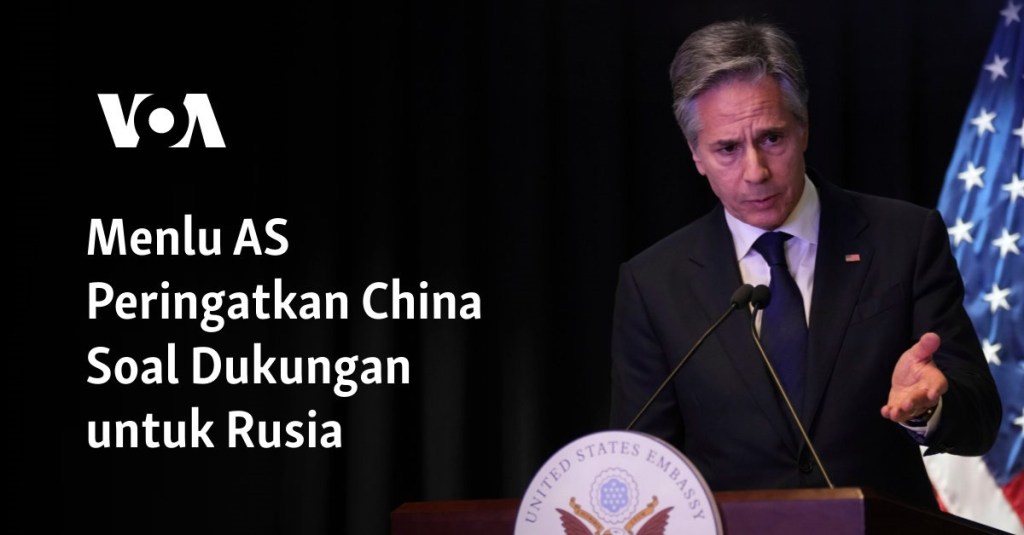
US Secretary of State Antony Blinken expressed “serious concerns” on Friday (26/4) regarding China’s support for Russia’s defense industry. He warned Chinese leaders that Washington could impose sanctions related to this issue. Blinken’s statement came in Beijing, shortly after his meeting with Chinese President Xi Jinping and other senior Chinese officials in a meeting that covered various disputes between the two superpowers. According to US officials, Blinken’s main agenda was the provision of goods by China such as microchips, machinery equipment, and other items used by Russia to manufacture weapons used in the war against Ukraine. “I told Xi, if China doesn’t address this issue, we will,” said Blinken.
China has defended its approach to Russia, stating that they are only engaged in normal economic exchanges with their main trading partner. In his opening statement on Friday, Xi did not mention the Russia-Ukraine issue. Instead, he focused on the need for US-China to enhance their relationship. “China and the US should be partners rather than competitors; helping each other succeed instead of harming each other, seeking common ground and eliminating differences, rather than engaging in fierce competition,” said Xi.
China has recently expanded its sanctions to include General Atomics Aeronautical Systems Inc. (GA-ASI) and General Dynamics Land Systems (GDLS) from the United States. This move comes after China had already imposed sanctions on Lockheed Martin and Raytheon for their involvement in supplying weapons to Taiwan. The decision to sanction GA-ASI and GDLS is seen as a response to their continued supply of weapons to Taiwan, which China considers a violation of its sovereignty. China has long claimed Taiwan as part of its territory and has been vocal about its opposition to any foreign interference in the Taiwan issue.
The sanctions imposed on GA-ASI and GDLS by China are expected to have significant implications for both companies. It is likely to impact their ability to conduct business in China and could potentially lead to financial losses. Additionally, these sanctions may also have broader implications for the US-China relationship, as tensions continue to rise between the two countries.
The US government has expressed its concern over China’s actions and has reiterated its commitment to supporting Taiwan’s defense capabilities. The US has long been a key ally of Taiwan and has provided military assistance to ensure its security. The imposition of sanctions by China on American companies involved in supplying weapons to Taiwan is likely to further strain the already tense relationship between the two superpowers.
As the situation continues to unfold, it remains to be seen how these sanctions will impact the defense industry and the broader geopolitical landscape. The US and China are engaged in an ongoing trade war, and tensions between the two countries have been escalating on various fronts. The imposition of sanctions on GA-ASI and GDLS is just the latest development in this complex and evolving relationship.
The international community will be closely watching the repercussions of these sanctions and their potential impact on global security and stability. As China flexes its economic and military muscles, the world braces for the consequences of this escalating conflict.
 TheLittleTwentieth - Renowned Papers Edition, AI Infused