Local sources from Ukraine: Радіо Свобода, Новинарня.
UK coverage: POLITICO Europe.
Ukraine’s Military Intelligence has admitted responsibility for the car-bomb assassination of pro-Russian lawmaker and ex-militiaman Mikhail Filiponenko in occupied eastern Ukraine. According to Ukraine’s military intelligence, Filiponenko was involved in organizing torture camps in the occupied territories of Luhansk, where prisoners of war and civilian hostages were subjected to inhumane torture. The intelligence agency revealed Filiponenko’s exact address and stated that they knew the whereabouts of other high-profile collaborators in the occupied territories. They also vowed to punish all war criminals.
The situation in Ukraine has been tense since the 2014 revolution and the subsequent Russian occupation of the eastern part of the country. The assassination of Filiponenko is the latest in a series of violent incidents that have taken place in the region.
On June 26th, the Dniprovsky District Court of Kyiv handed down a verdict in the case of the murder of Kherson civic activist Kateryna Handziuk. Former head of the regional council Vladyslav Manger and his accomplice Oleksiy Levin, known as “Moskal,” were sentenced to 10 years in prison each. The court found that it was Manger and Levin who ordered and organized the attack on Handziuk. The court also fully satisfied the civil claim of the victims and obliged the defendants to jointly pay UAH 15 million for the moral damage caused to Kateryna’s parents and husband.
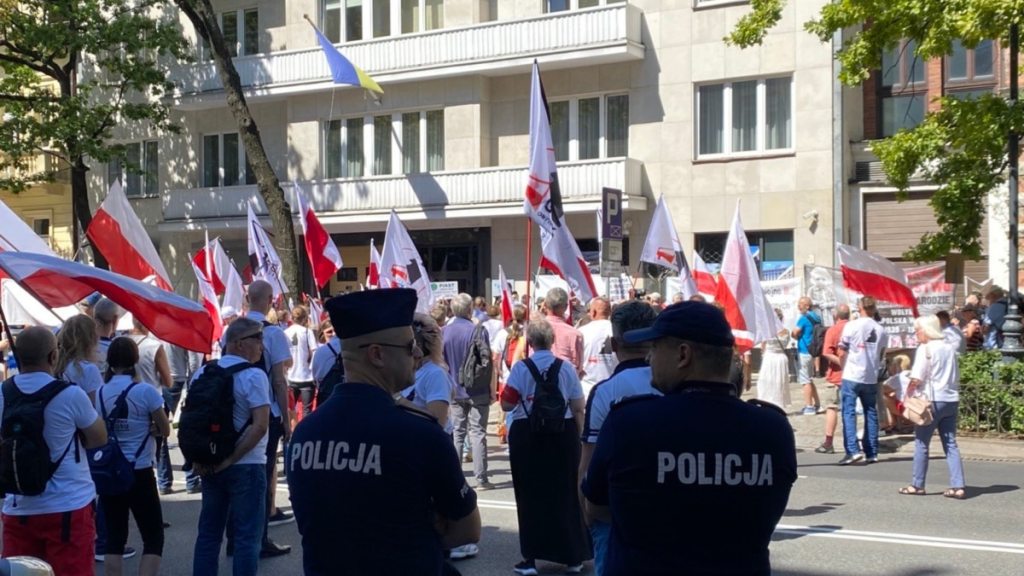
Meanwhile, pro-Russian forces in the Polish capital held a demonstration on Sunday under the name “Ukrainian Account Sunday.” Around two hundred Poles gathered near the Ukrainian embassy in Warsaw, considering the war in Ukraine as “fratricidal.” They held placards with slogans such as “This is not our war,” “Russia is not our enemy,” “No to Ukraine in NATO and the EU,” and “No cooperation with Ukraine, but with Russia and Belarus.” The protesters stated that Ukraine is not fighting for Poland, so Poland should fight for its own interests, not “for Ukrainian and American interests.”
The demonstration was organized by the Polish Anti-War Movement and the “Front” party, led by Krzysztof Tolwiński, a former member of the Polish Sejm. The protesters’ demands included ending the cult of the Ukrainian Insurgent Army (UPA) and the Organization of Ukrainian Nationalists (OUN), Stepan Bandera, and Roman Shukhevych, as well as eradicating “Banderaism” and “Nazism,” including the red and black symbolism.
The events in Volhynia began in 1942-1943 when the first killings of Poles took place, preceded by the killings of Ukrainians in Kholmshchyna in 1942. Mass actions ceased in the autumn of 1944. As a result of the actions of the Ukrainian Insurgent Army on one side and a number of Polish formations – nationalist, communist, and collaborationist with the Nazis – and Soviet saboteurs on the other, tens of thousands of Poles and Ukrainians were killed, mainly in villages in the western part of the former Volhynian Governorate with its center in Zhytomyr.
The authorities of Ukraine and Poland acknowledge the existence of complex issues of historical policy, collective memory, and tragic pages of both countries’ past. At the same time, with the start of Russia’s full-scale invasion, Kyiv and Warsaw actively cooperate in countering Russian aggression. Poland provides significant military assistance to Ukraine both within NATO and independently. The country has accepted several million refugees from Ukraine.
The assassination of Filiponenko and the sentencing of Manger and Levin demonstrate the ongoing tension in Ukraine and the region. The Ukrainian government is taking steps to punish war criminals and protect its citizens, while pro-Russian forces are attempting to disrupt the progress made by Ukraine and its allies. As the situation in Ukraine continues to evolve, it is important to remain vigilant and informed.
 TheLittleTwentieth - Renowned Papers Edition, AI Infused