Local sources from Italy: LA NAZIONE, t24.
UK coverage: BBC.
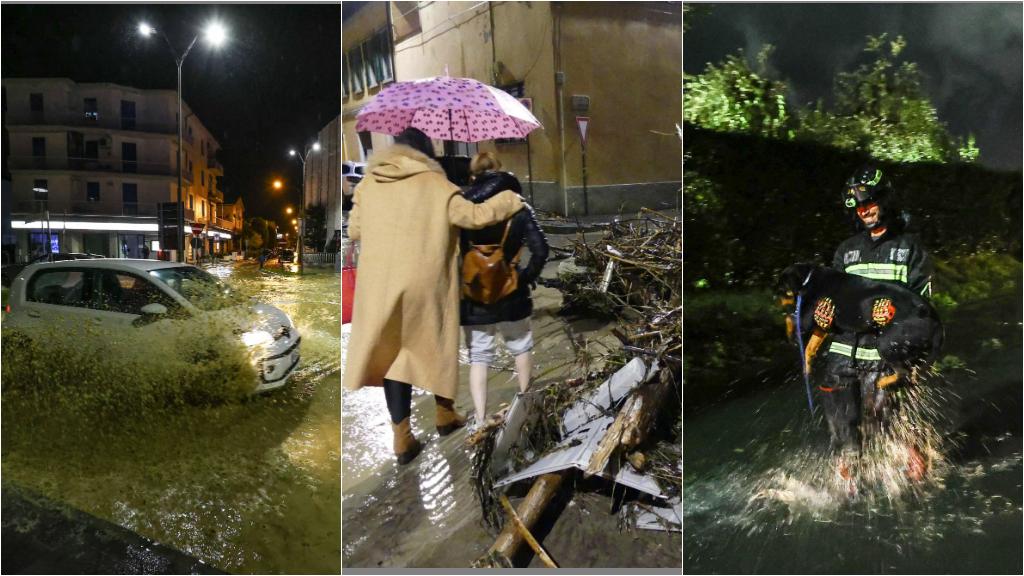
Six people have died in central Italy as a result of a storm and floods in the region of Tuscany. A man and his wife were found dead after their car overturned in floodwater in Vinci, near Florence. There were concerns that the River Arno would flood in Florence, but the situation improved by mid-morning. The storm and floods have caused significant damage in the area, with roads and bridges being washed away.
According to a report from LA NAZIONE, Giuseppe, who was evacuated after his house in Campi Bisenzio was flooded, said, “I heard a loud bang, water started coming in and reached the second flight of stairs, almost to the first floor where we had taken refuge. I heard my daughter crying and I got scared. Yesterday evening, we lost everything, we have nothing left.” Giuseppe and his family are among approximately 40 people currently being accommodated at Spazio Reale in San Donnino, where a space has been set up to welcome those who cannot return to their homes.
The initial provisional assessment of the impact of Storm Ciaran on Tuscany, according to an article from t24, is seven dead and millions of euros in damages. The overflowing of rivers such as the Bisenzio and the Furba, due to heavy rainfall that hit central Tuscany on November 2nd, caused widespread flooding in the area between Sesto Fiorentino and Pistoia, severely affecting cities like Prato, Campi Bisenzio, Quarrata, and Montemurlo. But problems were also encountered along the coast, from Livorno to Versilia, due to strong winds and the difficulty of the sea in accommodating the river’s overflow.
The government has declared a national state of emergency, announcing the allocation of 5 million euros for the most urgent measures. President of the Region, Eugenio Giani, said, “In four hours, if we look at each municipality, there was an average of 200 mm of rainfall. Not even during the 1966 flood did so much water fall in such a short period of time.”
Businesses at risk of production stoppages are also facing challenges. Maurizio Bigazzi, President of Confindustria Tuscany, said, “We are assessing the damages, which are significant, especially in the areas of Prato, Pistoia, the northern part of Florence, Pisa, Empoli, and Mugello.” He also added that it is essential that prevention and territorial defense become an integral part of the industrial policies of the region.
Artisan businesses are also reporting significant damage. Cinzia Grassi, Director of Cna Tuscany Center, said, “The area between Bagnolo, Montemurlo, and Montale is among the most devastated at the moment. We have reports of completely flooded artisan settlements in the area near the incinerator, and warehouses that are difficult to reach.”
The flood and strong gusts of wind have further worsened the situation for agriculture, which has already been affected by unfavorable weather conditions in recent months. Letizia Cesani, President of Coldiretti Tuscany, said, “The situation is very complicated in many areas of the region. Especially due to the overflowing of streams and rivers, which have flooded greenhouses and fields already sown with autumn crops such as cereals and fava beans.”
As of 4 p.m. on November 3rd, there were still 20,500 households without power, decreasing in the last two hours thanks to the work of 600 technicians. E-Distribuzione (Enel Group) has deployed 70 generators. In terms of transportation, the Prato-Pistoia and Prato-Vaiano-Vernio railway lines are still impassable due to flooding, while the A11 motorway has been reopened in both directions.
Undersecretary of the Interior Emanuele Prisco said, “In the past few hours, over 150 people have been rescued in the Prato area alone.” He added that 554 firefighters with four helicopters are involved in rescue operations in Tuscany.
The devastating storm and floods in Tuscany have claimed six lives and caused millions of euros in damages. The government has declared a national state of emergency and allocated 5 million euros for the most urgent measures. Businesses, artisans, and farmers have all reported significant damage, with some facing production stoppages. Rescue operations are currently underway, with over 150 people rescued in the Prato area alone. As the region continues to recover, it is essential that prevention and territorial defense become an integral part of the industrial policies of the region.
 TheLittleTwentieth - Renowned Papers Edition, AI Infused