Local sources from Russia: ФОКУС, nippon.com: Современный взгляд на Японию.
UK coverage: Press TV.
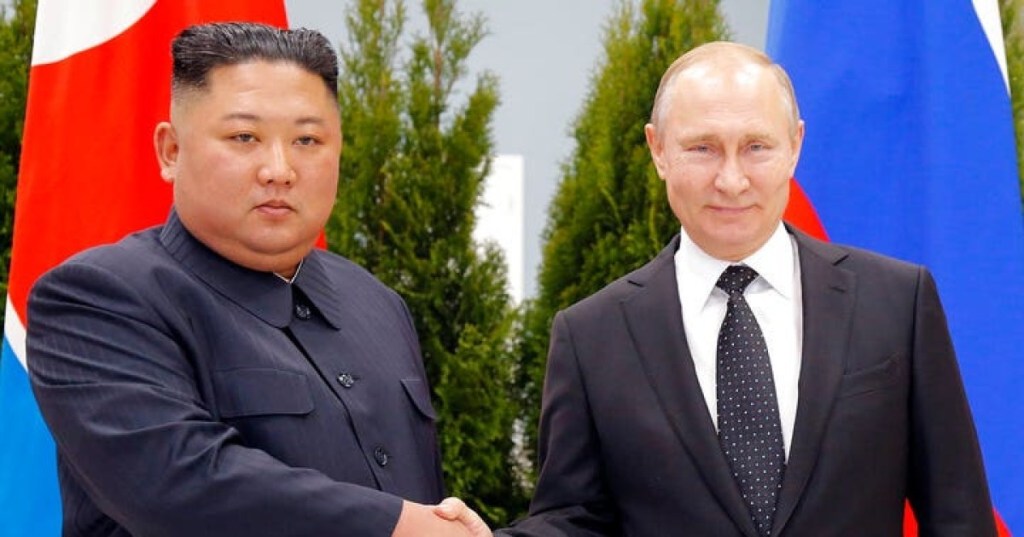
Russia and North Korea are attempting to establish closer ties in the face of what they perceive as hostile and aggressive actions from the West, led by the United States. This was made evident when North Korean leader Kim Jong Un visited a modern space base in Russia’s Far East on September 13, holding high-level talks with President Putin and agreeing to strengthen military cooperation. The rapid military convergence between these two countries suggests that they aim to involve China in the confrontation with Japan, the United States, and South Korea, shedding light on the structure of the “new Cold War” in Northeast Asia.
Interaction between two countries in complex situations and isolation
The previous summit between Russia and North Korea took place in April 2019. It is reported that the previous meeting was brief, with the countries only discussing “denuclearization,” which plays an important role in North Korea’s relations with the United States, and economic cooperation between Russia and North Korea. The discussion itself was rather cool. This time, on the contrary, in the conditions of deepening global isolation of the two heads of state, their need for each other becomes completely obvious.
It is said that Putin intentionally keeps foreign leaders waiting during meetings, but this time he personally waited for Kim Jong Un’s limousine in front of the spaceport, showing unprecedented hospitality. This is because, in addition to Western sanctions related to the invasion of Ukraine, the International Criminal Court (ICC) issued an arrest warrant for Putin in March this year on suspicion of war crimes, further deepening his isolation. First and foremost, it should be noted that Russian military forces suffer from a severe shortage of weapons, artillery shells, and ammunition to counter the large-scale counteroffensive by Ukrainian forces, which has intensified this summer. Therefore, Putin seems to be very interested in the supply of ammunition and shells available to North Korea.
A total of 11 resolutions of the United Nations Security Council have also been directed against Kim Jong Un by 2017 in connection with his nuclear and missile development program. In May and August of this year, North Korea conducted launches of intercontinental ballistic missiles under the guise of “military reconnaissance satellites,” which ended in failure. The situation received wide publicity worldwide, and the regime faced the threat of losing its own reputation and prestige.
Military cooperation as the basis of relations
The meeting, which Putin organized with great pomp, took place at the largest Russian base for advanced space development in the Far East. The fact that among Kim Jong Un’s entourage were many high-ranking military officials and leaders of satellite development organizations made the intentions of both sides obvious. Two partners met – one engaged in the development of missile and nuclear weapons prohibited by Security Council resolutions, and the other facing an ICC arrest warrant on suspicion of war crimes. At the same time, Putin is extremely interested in projectiles, weapons, and ammunition to enable his army to continue defending itself.
During the meeting, the two heads of state referred to each other as “comrades” and agreed to strengthen military cooperation. Kim Jong Un emphasized that he “supports all decisions” made by Putin regarding the invasion of Ukraine (*1). In response, Putin reportedly said, “We will support North Korea’s satellite program” (*2). However, specific details of the agreement and further actions are not disclosed. Firstly, previous resolutions of the United Nations Security Council prohibit the import of any weapons of North Korean origin, and Russia also voted in favor of these resolutions. If North Korea provides Russia with projectiles and ammunition, it would mean that a permanent member of the Security Council has violated the ban and will be criticized by the international community. It has also been noted that Russia may accept North Korean workers and engineers to address the labor shortage issue in Russia and in the occupied territories, but this would also violate Security Council resolutions.
Secondly, there are questions about the extent to which Russia will provide North Korea with its satellite and missile technologies. North Korea has experience in modifying weapons and technologies acquired from Russia and China, exporting them to third countries, including the Middle East, to obtain foreign currency. Providing North Korea with advanced developments without strict control over their further dissemination increases the risk of spreading dangerous technologies for the production of weapons of mass destruction worldwide, so Putin should be particularly cautious.
China’s expected reaction
In August, Japan, the United States, and South Korea held high-level talks at Camp David in the United States and agreed to expand their strategic cooperation in the Indo-Pacific region. Military cooperation between Russia and North Korea can be seen as an attempt to hinder this. North Korea relies on the support of China and Russia, but it has usually used diplomacy to balance between these two countries, seeking favorable results for itself.
And here again, the question arises about China’s reaction. It is reported that Russia is inviting North Korea to its annual naval exercises with China and proposing to conduct the first joint exercises between China, Russia, and North Korea. If this happens, it will clarify the image of the “new Cold War,” in which Japan, the United States, and South Korea will confront China, Russia, and North Korea.
However, many experts say that the increasing tension in Northeast Asia due to the rapid military convergence between Russia and North Korea is not in China’s interest (*3). For the administration of Xi Jinping, which seeks to make China a “responsible great power,” the escalation of the “new Cold War” could have a negative impact on China’s initiative to create the mega-economic zone “One Belt, One Road.” This is because worsening relations with the United States, which calls for “competition without confrontation,” will lead to new conflicts, in addition to the Taiwan issue.
Considering that the international community will perceive leniency towards military cooperation between Russia and North Korea as actions to circumvent sanctions, such an alliance will not be a good decision for China. To begin with, China maintains a certain distance from both the invasion of Ukraine and North Korea’s nuclear and missile development. A day before the Russia-North Korea summit, a representative of China’s Ministry of Foreign Affairs said, “This was coordinated between North Korea and Russia” (September 12), refraining from any comments. The United States is concerned about the sudden convergence of Russia and North Korea and is closely watching China’s reaction. Japan and South Korea also need to closely monitor the response of the Xi Jinping administration.
 TheLittleTwentieth - Renowned Papers Edition, AI Infused