Revised Article:
{
“Article_title”: “U.S. and Iran Exchange Prisoners in Sign of Thawing Relations”,
“Article_text”: “Five Americans who had been imprisoned in Iran for years were allowed to leave the country on Monday, President Biden announced, in a prisoner exchange between the United States and Iran. The exchange marks a significant development in the ongoing diplomatic relations between the two countries, and a partial thaw in the icy relations between the longtime adversaries.
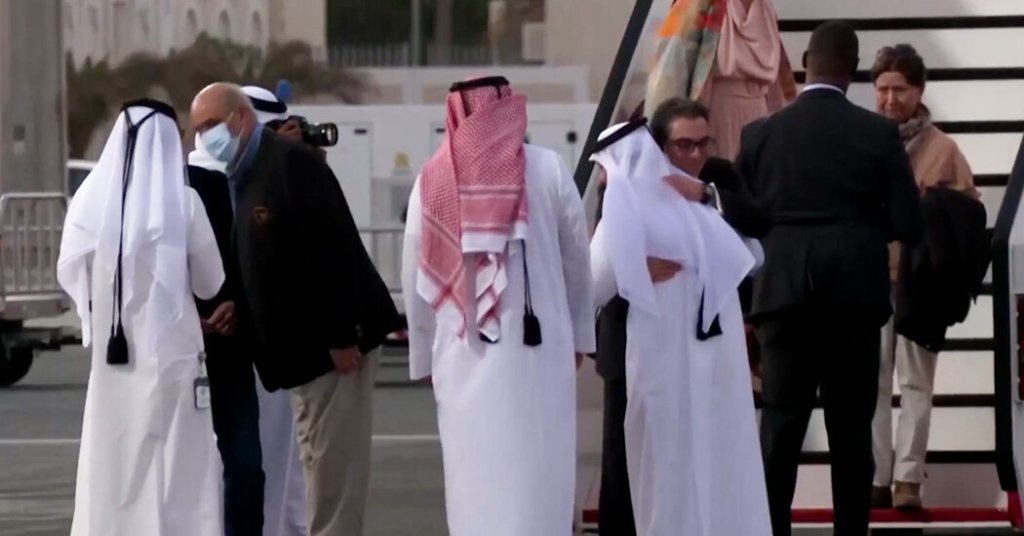
The five Americans – some of whom had been held in Evin Prison, one of the most notorious detention centers in Iran – flew to Doha, the capital of Qatar, for a Cold War-style exchange with two of the five Iranians. Three others declined to return to Iran, according to U.S. officials. The Americans were given a brief medical checkup in Doha before they boarded a U.S. government plane, and they landed at a military base in Virginia at 5:30 a.m. on Tuesday morning, according to a senior administration official.
The complex deal involved a carefully choreographed process by both Tehran and Washington, according to U.S. officials. The agreement also included the unfreezing of $6 billion in Iranian oil revenue held in South Korea, which may only be used for the purchase of humanitarian goods.
The prisoners’ release comes as a major relief to their families and supporters, many of whom have waited several years for their return from Iran’s notorious Evin Prison. It has also come under harsh criticism from Republicans in Congress opposed to any agreement that involves the unfreezing of Iranian funds.
The U.S. prisoners freed by Iran include Siamak Namazi, an Iranian American who had been behind bars in Tehran for nearly eight years, the longest duration the Islamic republic has jailed any American. Others include Morad Tahbaz, an Iranian American who also holds British citizenship, and Emad Shargi, an American Iranian dual citizen.
The United States released five Iranians, some of whom had been charged with crimes but not yet convicted. An Iranian official identified them as Kaveh Afrasiabi, charged with illicit lobbying, Reza Sarhangpour Kafrani, charged with exporting lab gear for Iran’s nuclear program in violation of sanctions, Mehrdad Ansari, serving five years in prison for acquiring military equipment, Kambiz Attar Kashani, who was accused of conspiring to export illegal goods, and Amin Hasanzadeh, charged with stealing sensitive planning information.
The deal signals a partial thaw in the icy relations between the United States and Iran, which remain at odds over a range of issues, including the rapid expansion of Tehran’s nuclear program, its ongoing military support for Russia, and Iran’s harsh crackdown on internal dissent.
The arrangement has raised hopes for more productive nuclear discussions. U.S. officials have insisted, however, that those talks are unrelated to the prisoner-exchange negotiations.
Sources: The New York Times, The Washington Post.”
}
 TheLittleTwentieth - Renowned Papers Edition, AI Infused